The $1.7 Trillion Housing Fix Canada Can't Afford Without Crowding Out Everything Else
Desjardins pegged the number at $1.7 trillion back in early 2026, and almost nobody understood what that actually meant. Not the dollar figure itself, that got headlines. What didn't land was the structural consequence: Canada would need to double its rate of residential investment for a decade straight, funneling capital into housing at a scale that necessarily starves other sectors. This isn't a housing problem with a housing solution. It's a capital allocation problem with no good answer.
The arithmetic is straightforward. Canada builds housing at roughly $85 billion annually in current investment. Getting to affordability by the early 2030s, the target window federal and provincial strategies keep citing, means sustaining somewhere north of $170 billion per year for ten years running. That's not a budget line item. That's a reorientation of the entire investment landscape. Pension funds, institutional capital, commercial lenders, private equity, all of it gets pulled toward residential construction because that's where the policy priority sits and where the returns follow policy priority.
What Gets Starved
The crowding-out effect isn't theoretical. When $1.7 trillion flows into a single asset class, it comes from somewhere. Canadian venture capital deployed roughly $6 billion into startups in 2025. Green energy infrastructure was targeting $40 billion over five years. Manufacturing retooling for the EV transition is on a similar scale. None of those sectors can compete with residential real estate when the federal government has made housing the stated economic emergency and every level of government is layering incentives, tax structures, and regulatory fast-tracks to make construction pencil.
The problem compounds because housing construction has some of the weakest productivity growth in the Canadian economy. Throwing more money at it doesn't double output, it bids up labor, materials, and land. The construction sector has been essentially flat on productivity for twenty years. So $170 billion per year buys fewer units than the math suggests, and the capital required creeps higher as costs inflate under the weight of demand. A $1.7 trillion target becomes $2 trillion halfway through if productivity doesn't shift.
And productivity won't shift without the kind of capital-intensive innovation that modular building, prefab systems, and construction tech require. But that innovation capital is exactly what gets redirected into financing another condo tower in Vaughan when housing is the policy fixation and everything else is secondary.
The Interest Rate Floor
The other piece nobody's modeling honestly: what does sustained demand for $170 billion per year do to borrowing costs? The Bank of Canada dropped rates through 2024 and into early 2025, but that was inflation-driven easing. Structural demand for capital on this scale creates upward pressure that monetary policy can't fully offset. Developers borrow. Buyers borrow. Municipalities borrow to fund infrastructure around new supply. The volume alone puts a floor under rates.
That floor might sit at 4%. It might sit at 5%. But it's not going back to 1.79%, and anyone pricing affordability around pre-2022 financing costs is building a plan that breaks on contact with reality. Higher sustained rates mean the monthly cost of ownership stays elevated even as prices theoretically moderate, which means affordability improves on paper but not in household budgets.
Who Actually Builds It
The final structural shift: $1.7 trillion isn't coming from individuals buying starter homes. It's coming from REITs, pension funds, and purpose-built rental developers. The economics of high rates and massive scale favor institutional ownership, not households. The "fix" to Canada's affordability crisis might restore housing supply while ending the ownership model that defined Canadian housing for sixty years. More units, fewer owners. Lower prices, more tenants.
That's not a conspiracy. That's just what happens when you try to solve a decade-long supply deficit with a single decade of capital-intensive construction in a high-rate environment. The money comes from institutions because individuals can't carry the risk. And once institutions own the stock, they optimize for yield, not homeownership rates.
The $1.7 trillion isn't unaffordable in the sense that Canada lacks the aggregate capital. It's unaffordable in the sense that spending it means not spending it on everything else that matters for the next ten years. Housing gets fixed. Innovation, manufacturing, and energy transition get delayed. That's the tradeoff nobody's pricing in.


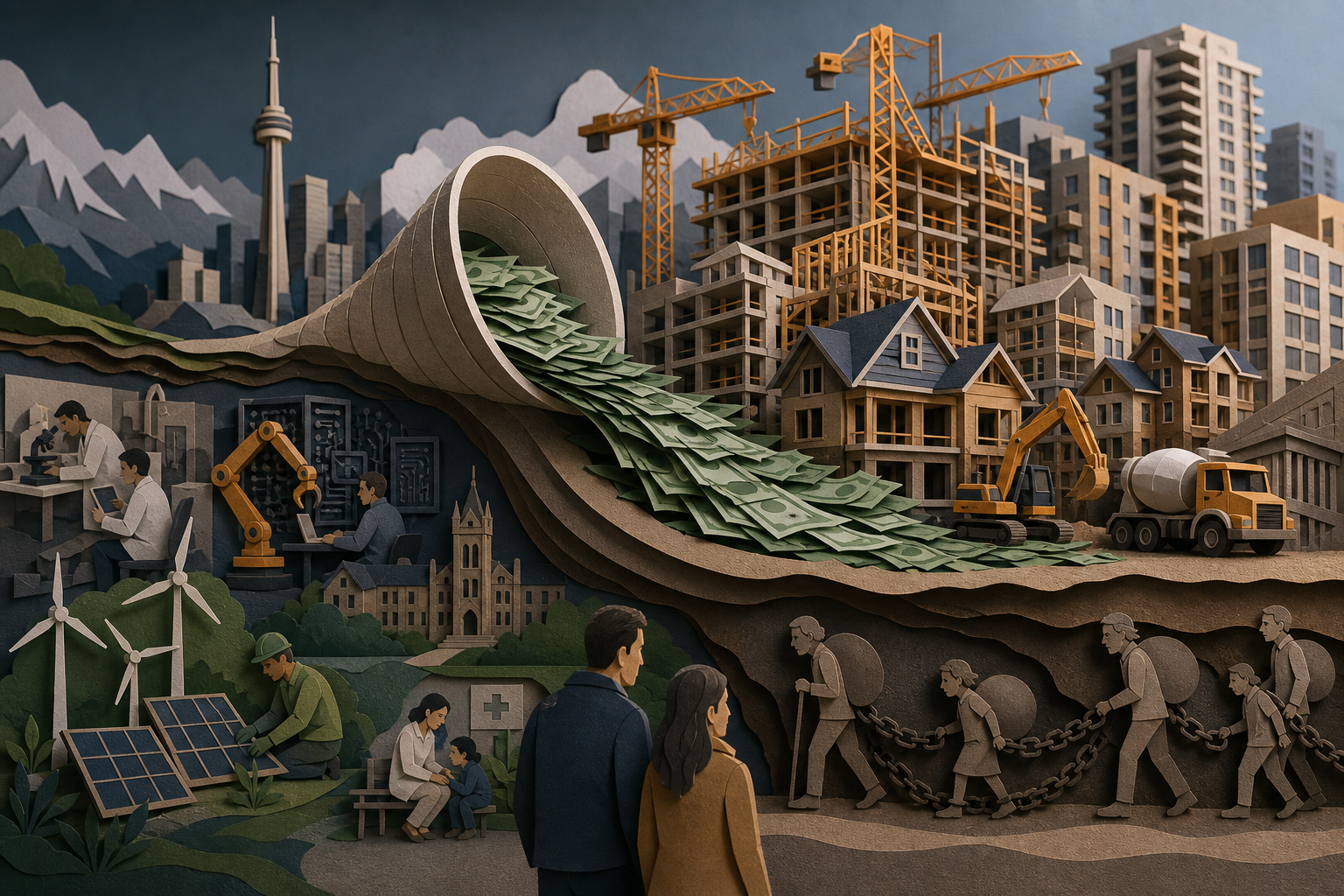

Desjardins pegged the number at $1.7 trillion back in early 2026, and almost nobody understood what that actually meant. Not the dollar figure itself, that got headlines. What didn't land was the structural consequence: Canada would need to double its rate of residential investment for a decade straight, funneling capital into housing at a scale that necessarily starves other sectors. This isn't a housing problem with a housing solution. It's a capital allocation problem with no good answer.
The arithmetic is straightforward. Canada builds housing at roughly $85 billion annually in current investment. Getting to affordability by the early 2030s, the target window federal and provincial strategies keep citing, means sustaining somewhere north of $170 billion per year for ten years running. That's not a budget line item. That's a reorientation of the entire investment landscape. Pension funds, institutional capital, commercial lenders, private equity, all of it gets pulled toward residential construction because that's where the policy priority sits and where the returns follow policy priority.
What Gets Starved
The crowding-out effect isn't theoretical. When $1.7 trillion flows into a single asset class, it comes from somewhere. Canadian venture capital deployed roughly $6 billion into startups in 2025. Green energy infrastructure was targeting $40 billion over five years. Manufacturing retooling for the EV transition is on a similar scale. None of those sectors can compete with residential real estate when the federal government has made housing the stated economic emergency and every level of government is layering incentives, tax structures, and regulatory fast-tracks to make construction pencil.
The problem compounds because housing construction has some of the weakest productivity growth in the Canadian economy. Throwing more money at it doesn't double output, it bids up labor, materials, and land. The construction sector has been essentially flat on productivity for twenty years. So $170 billion per year buys fewer units than the math suggests, and the capital required creeps higher as costs inflate under the weight of demand. A $1.7 trillion target becomes $2 trillion halfway through if productivity doesn't shift.
And productivity won't shift without the kind of capital-intensive innovation that modular building, prefab systems, and construction tech require. But that innovation capital is exactly what gets redirected into financing another condo tower in Vaughan when housing is the policy fixation and everything else is secondary.
The Interest Rate Floor
The other piece nobody's modeling honestly: what does sustained demand for $170 billion per year do to borrowing costs? The Bank of Canada dropped rates through 2024 and into early 2025, but that was inflation-driven easing. Structural demand for capital on this scale creates upward pressure that monetary policy can't fully offset. Developers borrow. Buyers borrow. Municipalities borrow to fund infrastructure around new supply. The volume alone puts a floor under rates.
That floor might sit at 4%. It might sit at 5%. But it's not going back to 1.79%, and anyone pricing affordability around pre-2022 financing costs is building a plan that breaks on contact with reality. Higher sustained rates mean the monthly cost of ownership stays elevated even as prices theoretically moderate, which means affordability improves on paper but not in household budgets.
Who Actually Builds It
The final structural shift: $1.7 trillion isn't coming from individuals buying starter homes. It's coming from REITs, pension funds, and purpose-built rental developers. The economics of high rates and massive scale favor institutional ownership, not households. The "fix" to Canada's affordability crisis might restore housing supply while ending the ownership model that defined Canadian housing for sixty years. More units, fewer owners. Lower prices, more tenants.
That's not a conspiracy. That's just what happens when you try to solve a decade-long supply deficit with a single decade of capital-intensive construction in a high-rate environment. The money comes from institutions because individuals can't carry the risk. And once institutions own the stock, they optimize for yield, not homeownership rates.
The $1.7 trillion isn't unaffordable in the sense that Canada lacks the aggregate capital. It's unaffordable in the sense that spending it means not spending it on everything else that matters for the next ten years. Housing gets fixed. Innovation, manufacturing, and energy transition get delayed. That's the tradeoff nobody's pricing in.
Read Next
25 States Sue Trump Over Tariffs, Testing the Outer Limits of Presidential Trade Power
Carney's Alberta Housing Tour Met Flag-Waving Separatists: Why Federal Money Can't Fix Regional Fury
Kelowna Now Ranks First in Canada for Wildfire Risk, What Condo Buyers Need to Know
IGM's $263M quarter and Winnipeg head office sale reveal the new economics of Canadian wealth management